His Excellency, Stavros Venizelos
Ambassador of Hellenic Republic in Australia.

Ambassador of Hellenic Republic in Australia.
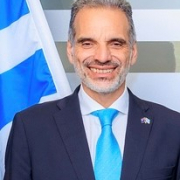
His Excellency, Stavros Venizelos, Ambassador of Hellenic Republic to Australia.
Non-resident Ambassador to New Zealand, Republic of Fiji, Papua New Guinea, Solomon Islands, Vanuatu, Kiribati, Nauru, Samoa and Tonga
Your Excellency the Honourable David Connolly, Administrator of the Northern Territory and Ms Susan Brosnan OLY
Honourable Minister, distinguished professors, dear members of the Hellenic community, ladies and gentlemen,
It is a great pleasure for me to address the 5th International Conference on the Hellenic Diaspora, organized by Charles Darwin University, the University of the Aegean, and the University of Macedonia.
Although I regret that I cannot be physically present with you in Darwin, I am honoured to participate through this message and to join you from Canberra in this gathering dedicated to the study, preservation, and future of Hellenism.
At the outset, I would like to acknowledge Sage RJ Lee for the Welcome to Country and to express, on behalf of Greece, our deep respect to the Larrakia people of Darwin, the Traditional Custodians of the land on which this Conference is taking place, and to their Elders past and present.
Darwin and the Northern Territory occupy a very special place in Australia. They are places where cultures meet naturally, where diversity is lived every day, and where communities maintain strong identities while contributing to a shared civic and cultural life. Greek culture forms an integral part of this remarkable multicultural mosaic.
In this context, I warmly acknowledge the Honourable Jinson Anto Charls, Minister for Multicultural Affairs of the Northern Territory. The multicultural success of the Northern Territory is something admirable, and the Greek community is proud to contribute to this coexistence of traditions, languages, and histories.
I would also like to express my sincere appreciation to Professor Fiona Coulson, Acting Vice Chancellor and President of Charles Darwin University, and Professor Maneka Jayasinghe, Acting Pro Vice Chancellor of the Faculty of Arts and Society, for their continuous support for Greek studies, and Greek civilization. Such support demonstrates an understanding that language and culture are not simply subjects of study; they are connections between peoples and generations.
A very special tribute must be paid to Associate Professor George Frazis, who leads the Hellenic and Greek Studies program in the Faculty of Arts and Society at Charles Darwin University. Through tireless effort and dedication, Associate Professor Frazis has achieved something remarkable: he has created a living link between the Northern Territory and Greece. His work promotes Greek Studies in a region geographically distant from Greece, yet deeply connected to Hellenic culture and identity.
The Embassy and the Ministry of Foreign Affairs of Greece strongly support the Hellenic and Greek Studies program of Charles Darwin University and consider it one of the best programs of its kind in Australia. Its academic quality, social outreach, and international orientation deserve praise.
I am also delighted to acknowledge the presence of two distinguished academics from Greece: Professor Dimitrios Papageorgiou, Rector of the University of the Aegean, and Professor Stylianos Katranidis, Rector of the University of Macedonia. Their participation reflects the meaningful cooperation between Australian and Greek universities, and I warmly congratulate them for this important initiative.
Allow me also to make a special mention of Dr. Angelica Poulos OAM, one of the extraordinary women of the Greek Diaspora in the Northern Territory. Through her leading role in the Guardians of the Greek Language and Culture, she has made an exceptional contribution to preserving language and cultural continuity for future generations.
Ladies and gentlemen,
I had the pleasure of participating in the previous Hellenic Diaspora Conference, and I can say with sincerity that it was an outstanding intellectual and cultural experience.
What impressed me most was the combination of scientific rigor and human sensitivity. The Conference demonstrated depth and diversity while preserving the stories, memories, and experiences of diasporic Hellenism with care and seriousness. It created a space where scholarship met lived experience, and where research remained connected to people and communities.
I was happy to participate then, and I am equally honoured to participate again this year.
This year’s agenda is exceptionally rich and inspiring.
The Conference explores diaspora institutions and community structures, the stories and innovative spirit of remarkable Hellenic women, and the fascinating history of the Greek Orthodox missions in Fiji, Tonga, and Samoa, as well as the presence of the Greek Orthodox Church in Western Australia.
It revisits the extraordinary histories of the Kalymnian diaspora during the twentieth century — stories of hardship, migration, and courage.
It also reflects upon the moving and tragic experiences of Greeks and Australians during the First and Second World Wars. Greece and Australia fought for the same values during those difficult times: freedom, democracy, and resistance against tyranny. Through those struggles, the bonds between our two countries became truly inextricable.
The Conference also highlights the literary contribution of Greek Australian women writers and addresses contemporary geopolitical themes, such as the evolving role of Greece in the Eastern Mediterranean.
Particularly important are the discussions on education and language: reimagining Modern Greek in the era of artificial intelligence, the perspectives of fourth-generation Greek Australians, the relationship between online and face-to-face learning, and the role of initiatives such as the Greek Museum of Adelaide.
I am also delighted that the Conference includes strong French “connection”: the Greeks of Marseille, Greek-French women writers, graphic novels, traditional literature, and contemporary short stories together paint a remarkable picture of the creativity and vitality of Greeks abroad.
And this is only the Australian dimension of the Conference — one that I proudly promote in my capacity as Ambassador of Greece to Australia. The participating Greek universities will also contribute their own important academic perspectives and research approaches.
Ladies and gentlemen, dear friends,
Conferences such as this are valuable because they remind us that Hellenism has never been static. Across generations and continents, Greek communities continue to adapt, create, contribute, and renew themselves while maintaining a living connection with language, memory, and culture.
In this spirit, I would also like to invite all of you to participate in the Forum on the Greek Language and its Teaching in Australia, which will be held in Melbourne, under the auspices of the Embassy of Greece, in February 2027, on the occasion of UNESCO World Greek Language Day. I hope this Forum will strengthen cooperation among educators, schools, universities, and communities dedicated to the future of Greek language education in Australia.
I am also looking forward with great interest to the opening of a branch of Charles Darwin University in Adelaide under the guidance of Associate Professor Frazis, serving the needs of the Greek community and deepening interaction with the universities of Adelaide.
Before concluding, I would like once again to congratulate all organizers, academics, researchers, students, and community members involved in this Conference. Your work preserves not only history and scholarship, but also the living presence of Hellenism across the world.
I wish every success to the 5th International Conference on the Hellenic Diaspora, and I look forward with particular interest to the keynote addresses of Dr. Peter Forrest and Associate Professor George Frazis.
Professional experience, Ministry of Foreign Affairs, Greece:
| March 2024 | Ambassador of Greece to Australia Non-resident Ambassador to New Zealand, Republic of Fiji, Papua New Guinea, Solomon Islands, Vanuatu, Kiribati, Nauru, Samoa and Tonga |
| 2022-Dec.2023 | Consul-General, Benghazi, Libya |
| 2019-2022 | Minister-Counselor, Embassy of Greece, Moscow |
| 2019 | MFA, Athens, A5 Directorate for Russia, Ukraine, Belarus, Moldova, South Caucasus & Central Asia |
| 2016-2019 | Seconded to Hellenic Parliament, Athens |
| 2013-2016 | MFA, Athens, C1 Directorate for European External Affairs |
| 2011-2013 | Permanent Representation of Greece to the UN, New York |
| 2008-2011 | Embassy of Greece, Ankara |
| 2005-2008 | MFA, Athens, A4 Directorate for Turkey |
| 2001-2005 | Permanent Representation of Greece to the EU, Brussels |
| 1998-2001 | Embassy of Greece, Belgrade |
| 1995-1998 | MFA, Athens, Diplomatic Office of the Foreign Minister |
Previous professional experience:
1987-1995 Attorney at Law, Athens
Studies: Law, Political studies
Foreign Languages: English, French, Russian
Marital status: Married, one son
Visit the Embassy here

 THE HONOURABLE JOHN CHRISTOPHER ANICTOMATIS AO